

DSPIAE Electric Reciprocating Sander Review: Is It Actually Worth It?
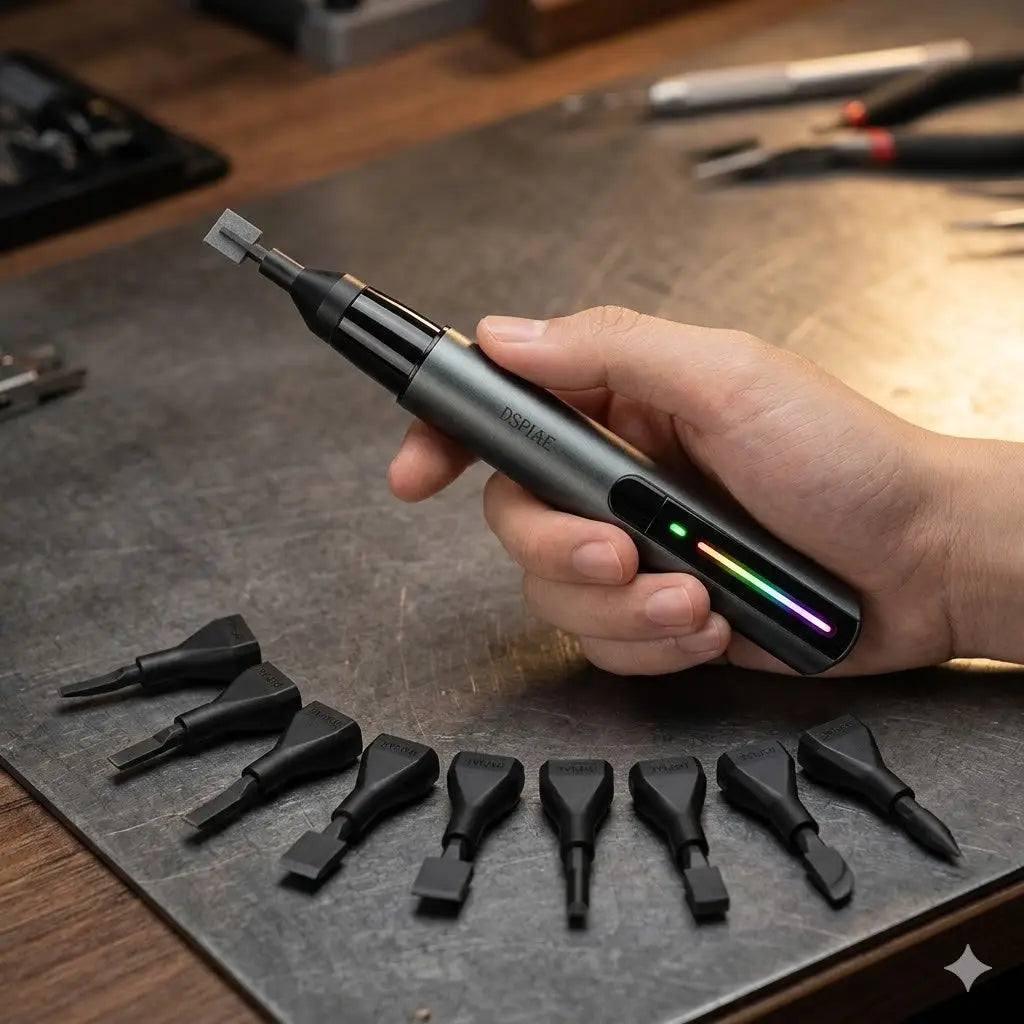
What the DSPIAE Electric Reciprocating Sander Actually Does
The DSPIAE ES-A is a handheld reciprocating sander — the head moves back and forth, not in circles. This distinction matters. Rotary tools (like a Dremel) spin at high RPM, creating circular scratch patterns that show through paint. The oscillating motion of the DSPIAE electric reciprocating sander replicates a hand sanding motion, consistently and without fatigue.
Specifications worth knowing:
- Three speed settings adjustable during use
- USB-C rechargeable — approximately 100 minutes of runtime per charge
- Multiple interchangeable head profiles included in the base set
- Standard accessories also compatible with the ES-A PRO
The Head System: What Each Profile Does
The interchangeable heads are where the DSPIAE electric reciprocating sander earns its versatility. The base set includes:
- Flat head: General panel work and large flat surfaces
- Narrow head: Reaches into recesses a flat pad can't access cleanly
- Angled head: Wing root joins, beveled edges on aircraft and AFVs
- Pointed head: Tight corners and specific detail areas
Extra head sets are available separately and share full compatibility between the ES-A and ES-A PRO. If you're building frequently, stocking a second set of your most-used profiles (usually the flat and narrow) saves changeover time. See why extra heads make a real difference.
Real-World Performance on Different Plastics
The DSPIAE electric reciprocating sander performs differently depending on the material:
Bandai styrene (Gunpla): Excellent at all three speeds. Clean, controlled removal with no crazing or melting near panel lines. This is the material the sander handles most comfortably.
Tamiya 1:35 scale model plastic: Same result. Slightly softer styrene responds well to the oscillating motion at medium speed.
Resin: Works well but generates significant fine dust. Wear a respirator and ensure ventilation — resin dust is a genuine health concern, not a precaution to skip.
Soft ABS plastic (older Gunpla, some third-party kits): Lowest speed only. ABS is more heat-sensitive than styrene. Let the paper do the work rather than applying downward pressure.
DSPIAE ES-A vs. ES-A PRO: Which One to Buy
The standard DSPIAE electric reciprocating sander (ES-A) handles most modeling tasks well. The ES-A PRO adds a stronger motor with tighter oscillation and more torque — meaningful differences for:
- Regular resin kit work where sustained motor load matters
- Frequent large-scale builds (1:32 aircraft, 1:16 armor) where surface area is significantly larger
- Builders who use the sander for multiple extended sessions per week
For occasional use or standard Gunpla and 1:35 scale builds, the standard ES-A is the more sensible starting point. A full comparison is available in the ES-A vs ES-A PRO comparison on the blog.
Where the DSPIAE Electric Reciprocating Sander Beats Hand Tools
The sander outperforms hand sanding sticks in specific, consistent situations:
- Long seam lines on aircraft fuselages and tank hulls where sustained even pressure matters
- Large flat panels on military vehicle upper surfaces
- Batch sanding — processing many identical parts in sequence
- Late-session work when hand fatigue degrades consistency
The time saving compounds across multiple builds. A builder who constructs one kit per month will notice a moderate improvement. A builder who works on multiple kits simultaneously will notice a significant one.
Where You Still Need Hand Sanding Tools
The DSPIAE electric reciprocating sander does not eliminate hand sanding. There are areas where sanding sticks remain the better tool:
- Sharp corners the sander would round
- Deep recesses narrower than the smallest available head
- Within 2mm of fine raised detail — the sander risks rounding it
- Any surface requiring tactile feedback to judge depth
Flexible Acrylic Sanding Sticks remain essential alongside the electric sander, not instead of it. Think of the sander as handling the bulk flat work while sanding sticks handle everything the sander can't reach.
Practical Tips for Getting the Most From This Tool
- Always start at the lowest speed — you can increase, but you can't undo over-sanding
- Test on a scrap sprue before touching the model — 30 seconds of testing saves potential mistakes
- The narrow head is the most versatile of all the profiles — prioritize it when buying extra head sets
- Use the sander dry for initial material removal; switch to wet sanding with flexible film above 1,000 grit
- After use, wipe the head attachment and sandpaper backing with a dry cloth to extend paper life
Verdict: Who Should Buy the DSPIAE Electric Reciprocating Sander?
If you build more than one model per month, the DSPIAE electric reciprocating sander pays back its cost in time saved and improved surface consistency within three to five builds. The improvement is most visible on long seam lines and large flat surfaces where hand sanding is hardest to keep even.
If you build occasionally — one or two kits per year — a quality set of sanding sticks and flexible sanding films handles your needs without the investment. The electric sander adds real value at consistent build frequency.
For anyone already using it regularly, the PRO upgrade is worth considering for resin and large-scale work. For everyone else, the standard ES-A is where to start.
If you're just starting out and want to understand the full role of sanding in a build, read How to Sand Scale Models first — it explains where the DSPIAE electric reciprocating sander fits into the overall process.