

Static Grass Applicator for Dioramas: How to Use It
The one tool that makes diorama groundwork look genuinely real — and how to get the most out of it on your first try.
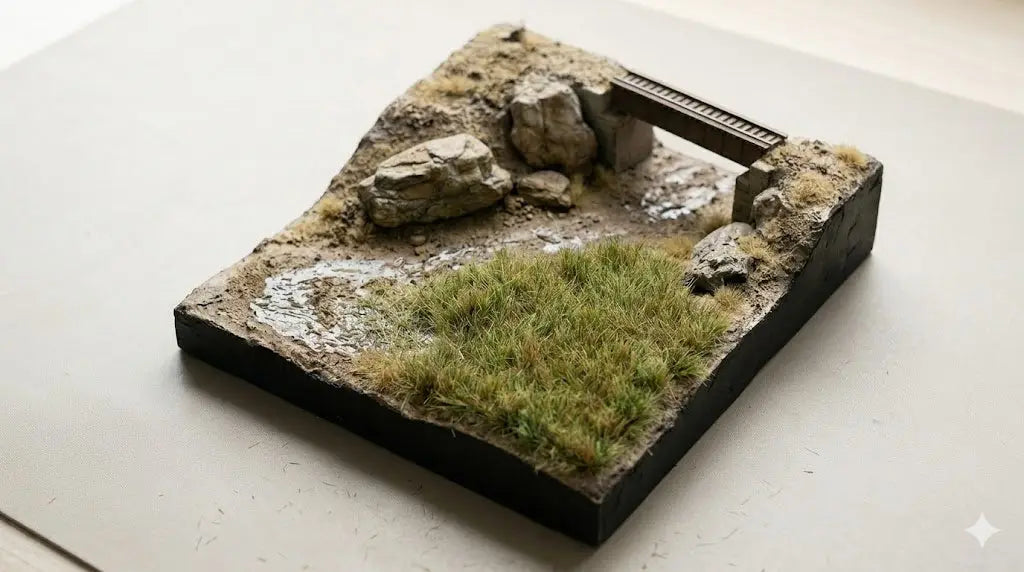
Static grass applied by hand lies flat. A static grass applicator makes it stand upright — the way grass actually grows. That single difference is what separates diorama groundwork that looks like a model from groundwork that looks like a field. This guide covers how a static grass applicator works, how to use it step by step, and the techniques that make the difference between acceptable results and genuinely convincing scenery.
How a Static Grass Applicator Works
A static grass applicator generates a low-voltage electrostatic charge — typically 5,000 to 15,000 volts at extremely low current, completely safe to handle. This charge is applied through a metal mesh sieve that holds the static grass fibers. When the charged fibers are released over a glued surface, they align with the electrostatic field and stand on their ends rather than falling flat.
The result is grass that grows vertically, the way it does in nature. Without the charge, gravity wins and fibers land horizontally no matter how carefully you apply them. The applicator removes that variable entirely.
Think of how a balloon rubbed on hair makes hair stand up. Same principle — electrostatic charge aligns the fibers with the field. The glued surface on your base is the ground; the applicator is the charging source. Fibers suspended between them orient vertically and stick that way as the glue dries.
What You Need Before You Start
The Applicator
Battery-powered (usually 2–4 AA batteries). Most applicators include a grounding cable with a pin or clip that connects to your base to complete the electrostatic circuit.
Static Grass Fibers
Comes in different lengths (2mm, 4mm, 6mm, 10–13mm) and colors. Shorter fibers for ground cover; longer fibers for taller grass and meadow effects. Mix colors for realism.
PVA Glue or Scenic Glue
Thinned PVA (50% water) or dedicated scenic glue applied to the base surface. The fibers must be applied while the glue is still wet.
A Prepared Base
Your diorama base with terrain texture already applied and basecoated. Static grass is a finishing layer — it goes over painted and sealed groundwork, not bare material.
Step-by-Step: Using a Static Grass Applicator
Prepare your base surface
Your base should be fully textured, painted and dry before applying static grass. Seal any groundwork materials (dirt, sand, gravel) with diluted PVA first so fibers stick to the surface, not loose material underneath.
Apply glue to the grass area
Use thinned PVA or scenic glue brushed onto the areas where you want static grass. Work in sections — the glue needs to be wet when you apply the fibers. Don't coat the whole base at once unless it's small.
Insert the grounding pin
Push the grounding cable pin through the base into the wet glue, or clip it to any metal part of the base. The grounding cable completes the electrostatic circuit — without it, the charge doesn't work and fibers fall flat.
Load and activate the applicator
Fill the sieve cup with static grass fibers (don't overfill — about 1/3 full works well). Switch on the applicator and hold it 2–5cm above the glued surface. The closer to the surface, the denser the fiber coverage.
Apply fibers in short taps
Gently tap the applicator housing to release fibers through the sieve. They'll stand upright on the glued surface immediately. Don't dump everything in one pass — work in layers for more natural density variation.
Let dry completely, then fix
Leave the base undisturbed for at least 30–60 minutes for the PVA to set. Once dry, apply a matte varnish spray from distance to lock the fibers permanently without flattening them.
Static Grass Fiber Length: Which to Use
| Fiber Length | Real-World Equivalent | Best Use | Scale |
|---|---|---|---|
| 2mm | Short-cropped lawn / dry ground cover | Urban bases, maintained turf, dusty ground | All scales |
| 4mm | Medium grass / field edge | General purpose groundwork, most diorama types | 1/35, 1/48 |
| 6mm | Tall wild grass / meadow | Overgrown areas, verges, rural dioramas | 1/35, 1/72 |
| 10–13mm | Long grass / reed beds / jungle undergrowth | Dense cover, dramatic foreground, tropical scenes | 1/35, 1/16 |
Mixing two or three fiber lengths in the same area is more realistic than using a single length throughout. Lay a base coat of 4mm fibers first, then add patches of 6mm in clusters to create variation in height. Shorter fibers between longer clumps fill the gaps naturally.
Common Mistakes with Static Grass Applicators
FAQ: Static Grass Applicators
Do I need a static grass applicator or can I apply it by hand?
You can apply static grass by hand, but it will lie flat and look like a texture rather than actual grass. The applicator is what makes fibers stand upright. For anything larger than a 5cm² patch, the visual difference is significant enough that the applicator is worth it.
Is a static grass applicator safe to use?
Yes. The voltage is high (5,000–15,000V) but the current is extremely low — the combination cannot cause injury. You may feel a mild static tingle if you touch the charged sieve, but it's not harmful. Keep it away from pacemakers and flammable vapors.
What glue should I use with a static grass applicator?
Thinned white PVA (50% water / 50% PVA) is the standard. It stays wet long enough to work with and dries clear. Dedicated scenic glue works equally well. Avoid fast-drying adhesives — the glue must remain wet when you apply the fibers.
What scales work best with a static grass applicator?
Static grass applicators work at any scale. The fiber length you choose matches the scale: 2–4mm fibers for 1/72 and 1/48 scale, 4–6mm for 1/35, 6–13mm for 1/16 and larger scales. For Gunpla diorama bases, 2–4mm fibers look proportional at most standard display scales.
Everything for Diorama Groundwork
Static grass, applicator and complementary scenery tools.