

Micro Drill Bits for Scale Models: Sizes, Uses and Technique
Which sizes you actually need, what each one is for, and how to drill cleanly without snapping bits.
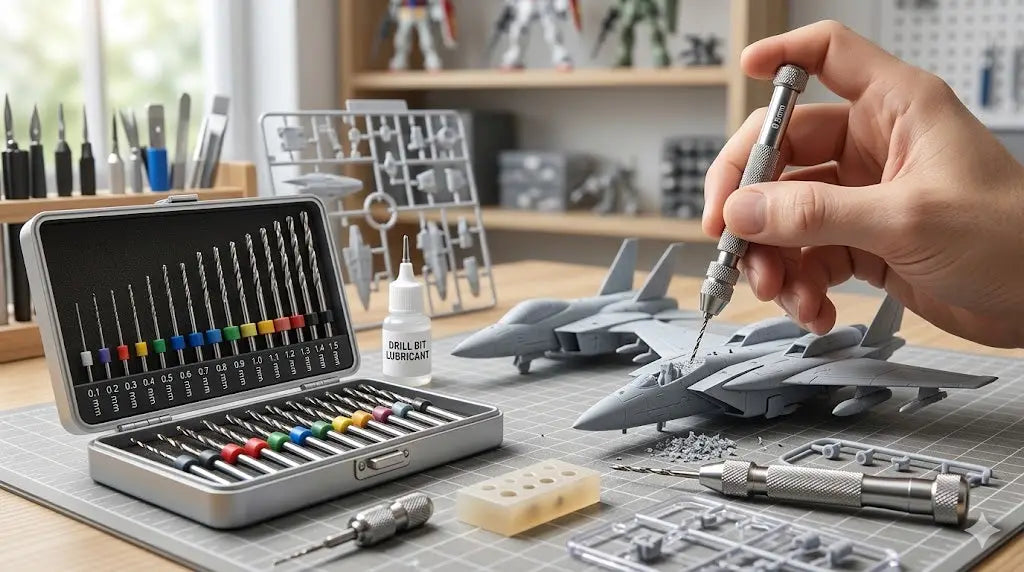
Micro drill bits for scale modeling cover a range from 0.3mm to 1.5mm — small enough that the wrong technique snaps them instantly, large enough to handle every precision drilling task in Gunpla, armor, aircraft and diorama work. Knowing which micro drill bit size you need and how to use it without breaking it is the difference between a clean addition of detail and a frustrating pile of snapped bits.
What Micro Drill Bits Are Used For in Scale Modeling
Micro drill bits are used anywhere you need to create a clean, precise hole in plastic or resin at scale. The most common applications are drilling out gun barrel muzzles for realistic depth, pinning parts together for structural strength, adding antenna and rod details, preparing surfaces for mounting magnets, and creating rivet holes in armor plate surfaces.
These tasks appear across every scale modeling discipline. In Gunpla, gun barrel drilling and magnet mounting are standard practice on any serious build. In 1/35 armor, rivet drilling and pinning resin parts are common. In ship modeling, drilling for rigging and antenna attachment points is essential.
A 0.5mm bit creates a hole 0.5mm in diameter. In 1/35 scale, 0.5mm represents about 17.5mm real-world — roughly the diameter of a large bullet hole or rivet. In 1/72 scale, the same bit represents 36mm. Choosing the right diameter for the scale is as important as the technique.
Micro Drill Bit Sizes: Which to Use for What
| Size | Primary Use | Notes |
|---|---|---|
| 0.3mm | Fine rivet holes, thin antenna bases | Snaps easily — low speed, light pressure only |
| 0.4mm | Rivet patterns, small pin holes | Still fragile — keep drill perpendicular |
| 0.5mm | Gun barrels (HG Gunpla), thin pin holes | Most common size for Gunpla barrel drilling |
| 0.6mm | Gun barrels (MG, RG), magnet prep | Good for 2mm magnet holes when stepped up |
| 0.8mm | Medium barrel drilling, pin connections | Reliable, low snap risk at correct speed |
| 1.0mm | Larger gun barrels, 1mm rod holes, magnets | Works well for most magnet socket preparation |
| 1.2mm | Structural pinning, larger magnet sockets | Robust — suitable for resin parts and metal pins |
Hand Drill vs Electric Drill: Which to Use
Both work. The choice depends on volume and control requirements.
A hand pin vise gives you complete control over speed and pressure — ideal for single precision holes where feel matters more than speed. For 0.3mm–0.5mm bits where snapping risk is highest, hand drilling is often safer because you feel resistance building before the bit snaps.
An electric drill like the DSPIAE Orbit Electric Hand Drill works faster and maintains more consistent perpendicular alignment than hand drilling. It's the better choice for repetitive drilling tasks — rivet patterns, multiple gun barrels, a row of antenna points — where fatigue from hand drilling introduces inconsistency.
How to Drill Cleanly Without Snapping Bits
Mark the drill point with a scriber or push pin
A small indent stops the bit wandering on the first contact. Without it, the bit slides across the plastic surface and the hole starts in the wrong place.
Start perpendicular and stay perpendicular
The most common cause of snapped bits is angled entry. The bit bends under lateral force and snaps. Hold the drill completely vertical before starting and maintain that angle throughout.
Drill in short steps, clear chips regularly
Back the bit out every millimetre of depth to clear plastic chips. Chips packed into the flutes increase resistance dramatically and snap small bits. Short steps keep the cutting path clear.
Use light, consistent pressure
Let the cutting edge do the work. For 0.3mm–0.6mm bits, the pressure should be barely more than the weight of the drill itself. Increase slightly for 0.8mm+ bits where the cutting edge can handle more load.
FAQ: Micro Drill Bits for Scale Modeling
What size drill bit for gun barrel drilling on Gunpla?
0.5mm for HG and SD grade guns; 0.6mm–0.8mm for MG and RG; 1.0mm–1.2mm for PG. Check the external muzzle diameter and use a bit slightly smaller than the outer diameter so you leave a visible barrel wall rather than drilling through the whole muzzle.
What size drill bit for magnets in scale models?
The most common hobby magnet sizes are 2mm and 3mm diameter. Use a bit 0.1mm smaller than the magnet diameter for a snug friction fit — a 1.9mm bit for 2mm magnets. Step up in increments to reach the final diameter rather than drilling directly to size.
Why do my micro drill bits keep snapping?
Three main causes: too much lateral pressure (keep the bit perpendicular), too much downward pressure (let the bit cut, don't force it), and chip buildup in the flutes (back out frequently to clear). Bits below 0.5mm snap very easily — reduce speed and pressure significantly on these sizes.
Drilling Tools for Scale Modeling
From 0.3mm bits to electric drills — all at Hobbyist Haven.