
Can't see small details when painting or building models
Eye strain, shaky hands and poor light make fine work harder than it needs to be.
Quick answer
Most fine-detail struggles come from light and support, not skill. Use a bright, neutral or daylight-colored lamp close to the work, magnify with a headband or bench magnifier at a comfortable working distance, brace your hands against each other or the table, hold the model in a holder instead of your hand, and work in short sessions. If vision remains difficult, an eye exam is worth having.
- TimeSetup: 15-30 minutes
- DifficultyBeginner
Safety first
- Take breaks to rest your eyes.
- Avoid glare from lamps directly into your eyes.
- If you have headaches or sudden vision changes, see a professional.
Is this your problem?
- Everything looks dim or yellowLighting: add a bright, neutral lamp. Start there.
- Details look fine in the light but you cannot place the brushHand support and magnification.
- Brush loses its point and wandersSee Brush lost its point (splayed bristles).
- Tiny parts keep vanishingSee Tiny parts flying off tweezers or getting lost.
- You see double, get headaches, or notice a sudden change in visionSee an eye care professional.
You'll see
You squint at tiny parts, paint outside the lines, lose track of what you are cutting or gluing, get headaches or tired eyes after a session, or your hands shake when you reach a small detail.
Likely causes
- Dim or yellow light.Low or warm light reduces contrast, so edges and small details blur.
- No magnification.Small details are at the edge of what unaided eyes can resolve, especially with age.
- Unsupported hands.Free-floating hands shake more than hands braced on the table.
- Long sessions.Tired eyes and hands lose precision and focus.
- Wrong working distance.Magnification that is too strong leaves no room for your tools.
What you need
- Bright lamp, neutral or daylight color
- Headband or bench magnifier with a comfortable working distance
- Model holder or painting handle
- Hand rest, such as a rolled towel
- Timer for breaks
How to fix it
- Add a bright, neutral lamp close to the work, angled so your hand does not cast shadows over the area.
- Choose magnification that still lets you hold a brush or tool comfortably; start low and increase only if needed.
- Mount the model in a holder so both hands are free and the work is at eye level.
- Rest your wrists on the table or brace your hands together when making fine strokes.
- Work on one tiny detail at a time, then step back and check at normal view.
- Take a break every half hour or so, look at something far away, and stretch your hands.
- Check your reading glasses prescription; if needed, ask about a pair set for close working distance.
What to avoid
- Painting in dim light.
- Magnification so strong you lose working distance.
- Holding the model in your hand.
- Working until your eyes ache.
Common wrong fixes
- Leaning in closer to the work, which strains the neck.
- Using a lamp that is behind or beside you and casts a shadow.
- Using strong magnification straight away without practice.
Not worth fixing, or time to ask us
Ask us which magnification suits your work.
By situation or hobby
Painting miniatures
A holder and brush support matter; low magnification is often enough.
Photo-etch and tiny parts
Higher magnification and a lit bench are useful.
Gunpla and kit assembly
Good light and a mat to catch parts help more than strong magnification.
Working with prescription glasses
Check if the magnifier fits over them or has an adjustable bridge.
Already ruined?
If you have already painted over something you could not see, step back and check in good light before fixing; most mistakes in tiny detail can be corrected with a fine brush and a fresh start on that spot. If vision is the issue and not your setup, an eye check is more useful than any tool.
Next time
- Set up your bench once with good light and a holder.
- Take regular breaks.
- Choose magnification by working distance, not by number.
- Keep the workspace uncluttered so tiny parts are easy to find.
Frequently asked questions
What magnification is good for model painting?
Many painters use low magnification with a comfortable working distance; very high magnification shortens it.
How do I stop shaky hands painting miniatures?
Brace your hands together and on the table, and hold the model in a holder.
What kind of light is best for model painting?
A bright, neutral or daylight-style lamp close to the work with no shadows over it.
Can I wear glasses with a headband magnifier?
Some designs are made to fit over glasses; check the product details.
Why do my eyes get tired when I paint?
Poor light, too-close work and long sessions. Improve light, add breaks and look into the distance between strokes.
Jargon explained
- Working distance
- The distance between lens and work at which the image is sharp, leaving room for hands and tools.
- Magnification (1x, 2x)
- How much larger an object appears; stronger magnification usually means a shorter working distance.
Tools that can help
-
Adjustable 5 Lens LED Light Headband Magnifier Glasses $32.95
Why it helps: A headband magnifier with five interchangeable lenses (1.0x to 3.5x) and an adjustable LED light; 3 AAA batteries are needed and not included.
How to use it
Choose the lens that keeps a comfortable working distance; the description notes the nose bridge is adjustable for use with prescription glasses.
-
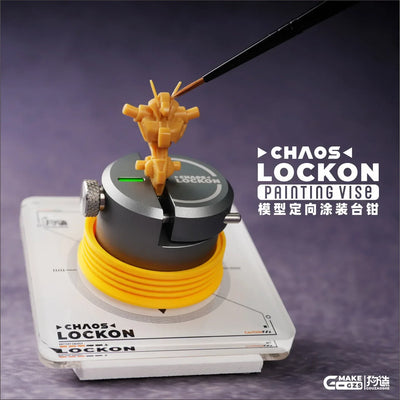
0/30/60º Rotating Painting Vise With Magnetic Base $45.95
Why it helps: A painting stand for figures and delicate objects that rotates and can sit flat or at 30 or 60 degrees.
How to use it
Hold the model steady so your hands are free for brushwork.

Reviewed November 3, 2026