
Static grass will not stand up
Fibres that lie flat on the glue. Usually the applicator is not grounded, the glue skinned over, or the fibres were sprinkled without a static charge.
Quick answer
Static grass stands up only when the fibres are charged and pulled into wet glue by an electric field. Push the applicator's grounding pin or wire into the wet glue (or a nail through it), glue small areas so they stay wet, hold the applicator a few centimeters above the glue and shake gently, then leave it to dry before touching. Glue that has skinned over, fibres that are damp or too long, or a weak battery all make grass lie down.
- Time10-20 minutes per patch, plus drying
- DifficultyBeginner
Safety first
- Applicators produce high voltage at very low current: do not touch the mesh and ground pin together, and keep them away from people with pacemakers. Follow the maker's instructions.
Is this your problem?
- Nothing stands up at allApplicator not grounded, switched off or battery weak.
- Fibres stand at first, then fallGlue too thin or watery, or touched before dry.
- Fibres clump in tufts or ballsFibres are damp or the container was squeezed; dry and loosen them.
- Edges stand but the middle is flatThe glue skinned over: work smaller areas.
- It stands up but looks like carpetSee Grass that looks like carpet.
You'll see
The grass fibres lie flat on the glue, clump, or only a few stand up, so the surface looks like felt.
Likely causes
- Applicator not grounded to the glueThe charge needs a path: the grounding pin in the wet glue creates the field that pulls fibres upright.
- Glue skinned overFibres need wet glue to stick upright; skinned glue lets them settle flat.
- Sprinkled by handWithout a charge, fibres fall at random and lie down.
- Damp fibres or high humidityMoisture makes fibres clump and weakens the static effect.
- Fibres too long for the applicatorLong fibres need a stronger field; some applicators struggle with them.
- Weak battery or applicator held too far awayA weaker field cannot pull fibres upright.
What you need
- Static grass applicator
- Scenic glue (PVA-type, not too watery)
- Grounding pin, wire or a metal nail
- Static grass fibres
- Vacuum or soft brush for loose fibres
How to fix it
- Glue a small area only (palm-size or one base).
- Push the applicator's grounding pin or a metal nail into the wet glue; clip the ground lead to it if your applicator has one.
- Load fibres loosely into the applicator without packing them.
- Switch on and hold it a few centimeters above the glue, shaking gently; do not touch the glue with the mesh.
- Move to the next area only once this one is covered.
- Let it dry fully, then turn the piece over gently or vacuum lightly to remove loose fibres for reuse.
What to avoid
- Pressing the grass down with your fingers.
- Spreading glue over a large area at once.
- Touching the glue with the applicator mesh.
Common wrong fixes
- Watering the glue down a lot to keep it wet longer: it often stops fibres standing up.
Not worth fixing, or time to ask us
If an area has dried flat, it is usually quicker to add another layer of glue and grass over it. Ask us if your applicator does not lift fibres even when grounded.
By situation or hobby
Small wargaming bases
A pin or nail through the base into the glue works as the ground; some people stand the base on a metal tray.
Large railway layouts
Work in patches; re-place the ground pin as you go so every area is close to it.
No applicator
You can puff fibres from a squeeze bottle and blow them up as they dry, but results are weaker; tufts are an alternative.
Second layers
Use a spray-on or thin glue layer over the dry first layer and apply again.
Already ruined?
If an area dried flat, apply a fresh layer of glue over it and apply grass again with the applicator; it is usually quicker than removing it.
Next time
- Always ground the applicator in the glue.
- Glue small areas.
- Keep fibres dry.
- Use fresh batteries.
- Do not touch until dry.
Frequently asked questions
Why is my static grass not standing up?
Most often the applicator is not grounded into the wet glue, the glue skinned over, or the fibres are damp.
How does a static grass applicator work?
It charges the fibres and, with a ground pin in the glue, creates a field that pulls them upright into the glue.
Can you apply static grass without an applicator?
Yes, but the grass lies flatter; puffer bottles help a little. Tufts are an easy alternative.
What glue is best for static grass?
A PVA-type scenic glue that is tacky, not watery. Dedicated scenic glues work well.
How close should I hold the applicator?
A few centimeters above the glue, without touching it.
Jargon explained
- Grounding pin
- The pin or lead from the applicator pushed into the wet glue to complete the static field.
Tools that can help
-
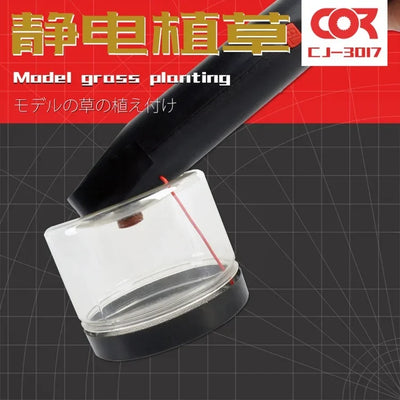
Cormake Static Grass Applicator & Tuft Plates from $14.49
Why it helps: A static grass applicator: the tool that stands the fibres up while the glue is wet.
How to use it
Follow the applicator's instructions for connecting it to the glue, and apply grass immediately after gluing; check the product details.
-
NightWorks 120ml Diorama Scenery Fluids from $20.95
Why it helps: Water-based scenic adhesives with a fine applicator nozzle for controlled placement.
How to use it
Lay glue in small patches just before applying grass.
-
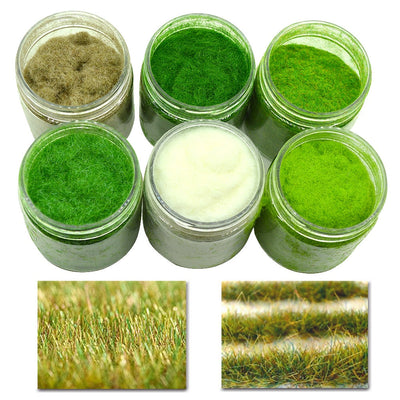
2mm Static Grass Powder (muliple colors) from $19.99
Why it helps: Fine 2mm grass for HO, N and OO scale.
How to use it
Use it as the first layer, then add taller fibres.
-
Scenery Fixative Spray for Dioramas from $17.95
Why it helps: A fixative misted over finished groundwork to lock static grass and ballast in place.
How to use it
Mist it over the grass once dry.


Reviewed November 3, 2026