
Static grass that looks like carpet
Ground cover that reads as a flat green mat rather than real grass. Variety in length, color and density is the fix.
Quick answer
Grass looks like carpet when it is one color, one length and one even density everywhere. Paint the ground an earth color first, mix two or three fibre lengths and shades (including some straw and brown), apply in patches and layers rather than wall to wall, let some ground show through, and add tufts and taller grass where real grass would grow longer, such as along edges and fences.
- Time30-60 minutes per base or small layout section, plus drying
- DifficultyBeginner
Safety first
- Wear a dust mask when working with a lot of loose fibres and pigments.
Is this your problem?
- Fibres lie flatSee Static grass will not stand up.
- Uniform color and lengthVariety problem: this page.
- Grass too long or too short for the scaleMatch fibre length to scale (see variations).
- Grass sheds or rubs offSeal with a scenery fixative once dry.
You'll see
An even, uniform green surface that looks like a lawn or felt, with no bare patches, color variation or height variation.
Likely causes
- One color and one lengthReal grass is never one green; it mixes fresh, dry and dead blades at different heights.
- Even, wall-to-wall coverageReal ground has worn paths, bare earth and patches.
- Grass lying flatFlat fibres look like felt; standing fibres look like grass.
- Wrong length for the scaleToo-long fibres at small scales read as a hayfield; too-short at large scales looks like a putting green.
What you need
- Earth-colored paint or textured ground
- Static grass in 2-3 lengths and shades
- Scenic glue (PVA-type)
- Static grass applicator
- Tufts or long fibres
- Optional: weathering pigments, scenery fixative
How to fix it
- Paint or texture the ground in an earth color first so gaps look like soil, not a white base.
- Mix a base blend of short grass in two or three shades, including a little straw or brown.
- Apply glue to irregular patches, not the whole area.
- Apply the base blend with a static applicator so it stands.
- Once dry, add a second layer of longer fibres in a few areas (edges, around rocks, fence lines) with fresh glue.
- Add tufts and a few taller clumps sparingly, then dust with an earth pigment on paths and wheel areas if you like.
- Seal with scenery fixative once everything is dry.
What to avoid
- A single flat color across the whole area.
- Gluing a large area before applying grass, as the glue skins over.
- Fibres too long for the scale.
Common wrong fixes
- Spraying the whole area with one green paint: it makes the carpet effect worse.
Not worth fixing, or time to ask us
On very small bases a single color may be perfectly fine. Ask us which lengths suit your scale.
By situation or hobby
Model railways N and HO/OO
Short fibres around 1-2mm for N and 2-4mm for HO/OO are typical for mown grass; longer for wild areas.
1/35 dioramas and figures
Longer fibres (around 4-6mm, and taller clumps) read better at larger scales.
Wargaming bases
Tufts often look better than wall-to-wall grass on small bases.
Seasons
Autumn/winter: more straw and brown. Desert: sparse yellow tufts only.
Already ruined?
Grass already looks like carpet? Do not strip it: dry-brush or lightly airbrush some areas with lighter and yellower greens, add patches of longer grass and tufts over it with fresh glue, and scuff a path with a brush and earth pigment.
Next time
- Always mix colors and lengths.
- Work in patches and layers.
- Paint the ground first.
- Use reference photos.
Frequently asked questions
How do you make static grass look realistic?
Mix lengths and shades, apply in layers and patches, let earth show through and add tufts.
What length static grass for HO scale?
Around 2-4mm for short grass is typical, with longer fibres for wild areas.
Can you layer static grass?
Yes. Let the first layer dry, apply fresh glue in patches and add a second layer of longer fibres.
How do I stop static grass falling off?
Seal it with a scenery fixative spray once dry.
Jargon explained
- Static grass
- Short nylon fibres that stand upright when applied with a static charge.
- Tuft
- A small pre-made clump of grass on a clear adhesive base.
Tools that can help
-
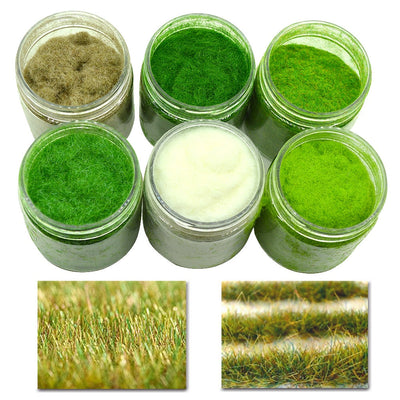
2mm Static Grass Powder (muliple colors) from €23,95
Why it helps: 2mm fibres sized for HO, N and OO layouts, for fine ground cover at small scales.
How to use it
Use it as the base layer, mixing two shades.
-
125ml/Bottle 10-13mm Long Static Grass €22,95
Why it helps: 10-13mm fibres for tall wild vegetation and overgrown patches.
How to use it
Add it in small clumps over the short grass.
-
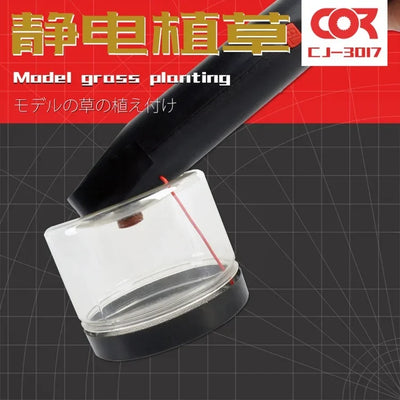
Cormake Static Grass Applicator & Tuft Plates from €17,95
Why it helps: A static grass applicator, with optional plates for making your own tufts.
How to use it
Stand the fibres up in the glue and make tufts for variety.
-
TEMOD Mud-Textured Scenic Glue from €15,95
Why it helps: A colored, mud-textured glue that holds grass and leaves a soil-like finish around it.
How to use it
Use it for patches so the glue line itself looks like earth.
-
Galaxy Model Weathering Pigments from €15,95
Why it helps: Pigments for simulating dust, sand and soil as a final layer.
How to use it
Dust paths and worn areas after the grass is dry.



Reviewed November 3, 2026