
Grainy or orange-peel airbrush finish
Paint that dries rough like sandpaper, or dimpled like orange peel. Either it dried before landing or it landed too thick to level.
Quick answer
A grainy finish means the paint is drying in the air before it reaches the model: too far away, too much pressure, paint too thick or drying too fast. Orange peel means wet paint landed but could not level out: usually too thick, too little thinner or pressure too low for the paint. Adjust thinning, distance and pressure on test card until a light wet coat lays down smooth. Sand out the texture with fine grits and recoat, or polish gloss coats once cured.
- TimeAdjusting: 10 minutes. Repair: 30-60 minutes plus curing.
- DifficultyIntermediate
Safety first
- Wear a dust mask when sanding paint; ventilate and use a suitable respirator when spraying.
Is this your problem?
- Rough, dusty and mattPaint drying before it lands (dry spray).
- Smooth but dimpledOrange peel: paint too thick to level.
- Separate specks and dotsSpitting: see Airbrush spitting.
- Individual lumps of dust or fibresSee Dust in the paint or varnish.
- Spray-can primer looks fuzzySee Primer grainy or fuzzy.
You'll see
Grainy: a dry, rough, sandpaper-like or dusty texture. Orange peel: a dimpled surface like an orange skin, most visible on gloss car bodies and Gunpla.
Likely causes
- Spraying from too far awayDroplets travel long enough to dry and land as dust.
- Pressure too high for the paintFast air dries droplets in flight and blows them about.
- Paint too thickThick paint atomises coarsely: droplets land as bumps (orange peel) or dry rough.
- Thinner evaporates too fastFast thinners and warm, dry air stop the paint from flowing out.
- Pressure too lowPoor atomisation gives larger droplets that cannot level.
What you need
- Paint maker's thinner (and levelling thinner/retarder if offered)
- Pipette
- Test card or spare part
- Fine sanding sponges (#1500 and finer)
- Polishing compound for gloss
How to fix it
- Thin the paint a little more, measuring with a pipette so you can repeat it.
- Test on card at about 5-10cm (2-4in) distance for general coats, closer for detail.
- Adjust pressure in small steps: lower it if grainy, raise it slightly if spattery or orange-peel.
- Aim for light coats that just look wet as they land, then let them flash before the next pass.
- Repair an existing grainy area: let it dry, smooth with a fine sanding sponge, wipe off dust and spray a light wet coat.
- Repair orange peel on gloss: after full cure, wet-sand flat with very fine grits and polish with compound, or apply a final levelling coat.
What to avoid
- Spraying from far away to avoid runs.
- Very high pressure for general coverage.
- Sanding gloss before full cure.
Common wrong fixes
- Piling on more coats to bury grain: texture stays and runs start.
- Polishing a grainy matt finish: it creates shiny patches.
Not worth fixing, or time to ask us
If you cannot get a smooth coat after adjusting thinning, distance and pressure, tell us your airbrush, nozzle size and paint brand.
By situation or hobby
Gloss car bodies
Most visible. Many builders lay a final wetter coat with a levelling thinner, then polish after full cure.
Matt camouflage on armor
A slight dry texture is often invisible after weathering; fix only obvious grain.
Metallics
Metallics like light dry coats; too wet can darken or mottle. Do not over-thin unless the maker says.
Primers
Primer grain can be sanded smooth before color.
Already ruined?
Grainy: sand smooth and recoat. Orange peel: wet-sand flat after full cure and polish, or add a levelling coat. Severe cases: strip and repaint.
Next time
- Test spray every new mix.
- Keep a consistent distance.
- Measure thinning.
- Avoid hot, dry or very cold rooms.
Frequently asked questions
Why is my airbrush paint grainy?
It is drying before it lands: too far away, too much pressure, too thick or too fast-drying. Thin a little, move closer and lower pressure.
What causes orange peel when airbrushing?
Paint landing too thick to level, often from too little thinner or too low pressure.
Can you sand out orange peel on a model?
Yes, after full cure: wet-sand with very fine grits, then polish.
How far should I hold my airbrush?
For general coats many modellers work around 5-10cm (2-4in); closer for detail with lower pressure.
Jargon explained
- Dry spray
- Paint that dried in the air and landed as dust.
- Orange peel
- A dimpled texture from paint that could not flow out flat.
Tools that can help
-
1ml Graduated Glass Pipette 1,200 kr
Why it helps: A graduated glass pipette usable with acrylics, enamels, lacquers and their thinners for precise mixes.
How to use it
Measure paint and thinner so a good mix can be repeated.
-
Nasedal 15-36PSI Portable Air Compressor with LED Display 14,700 kr
Why it helps: A portable compressor with an LED display showing the pressure.
How to use it
Change pressure in small, visible steps while you test.
-
Stedi 10pcs/box #400~15000 3mm Sanding Sponges from 1,500 kr
Why it helps: Sanding sponges up to very fine grits that follow curves.
How to use it
Smooth a grainy area before recoating, or level orange peel before polishing.
-
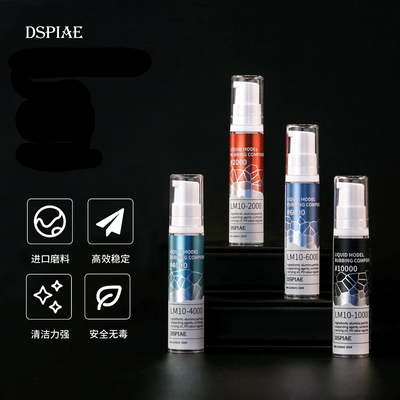
DSPIAE Liquid Polishing Compound from 2,600 kr
Why it helps: Liquid polishing compounds from #2000 to #10,000.
How to use it
Polish gloss coats after wet-sanding orange peel.


Reviewed November 3, 2026